
ANCHOR WAVE · Issue 001
Access Tools & Support Packs
The primary ANCHOR WAVE collection joins communication access, support tools, public routes, system explainers, and print-ready education.
Read in live magazine ↗ANCHOR WAVE, Arkansas Unfiltered, LITERAL, and special editions bring long-form reporting, lived experience, public education, visual explainers, support scripts, research translation, print layouts, and system guides into one reading room.
Issue shelf
The live reader currently reports 87 pages and 66 spreads/layouts across three public collections.
The primary ANCHOR WAVE collection joins communication access, support tools, public routes, system explainers, and print-ready education.
Read in live magazine ↗A compact edition for explaining ANCHOR Arkansas to public readers, reviewers, partners, and decision-makers.
Open collection ↗A public-education edition centered on plain language, visible support, and systems people can understand before overload.
Open collection ↗Reading options
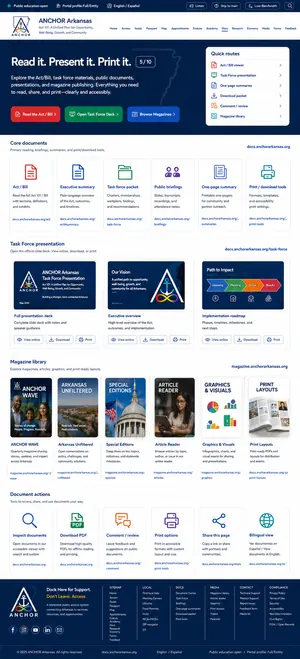
The live reader preserves finished magazine design while offering lower-density ways to move through the same material.
Reader controls
Series + imprints
Feature reporting, system explainers, visual education, support tools, campaigns, research translation, and Arkansas navigation.
Direct reporting and commentary about Arkansas systems, lived experience, barriers, rural access, family systems, and public response.
Plain-spoken essays, first-person work, language-focused writing, and pieces that do not require the reader to translate institutional jargon first.
Focused issues for public review, CARD, schools, healthcare, legislation, training, task-force work, and access campaigns.
Article Desk
The current Article Desk is organized around the access problems readers actually encounter.
Communication tools work only when the receiving system accepts the communication.
The visible card is communication; it should not create another interrogation.
PassportA voluntary access profile should improve communication without becoming an eligibility test.
CommunicationTyping, writing, pointing, AAC, and showing information can be more reliable than forced speech.
InfrastructureWritten options, AAC, interpreters, captions, and response systems belong in ordinary access.
Autonomy, burnout, work, housing, caregiving, aging, and continuity.
Adult support has to work across the connected system of ordinary life.
AutonomyDirect adult access and caregiver support should exist without erasing either role.
ContinuityContacts, routines, medicines, preferences, and backup plans need durable handoffs.
LifespanSupport has to survive transitions across age, school, work, healthcare, housing, and caregiving.
Higher supportComplex needs require more structure, time, communication support, and clearer handoffs.
Early support and school safety should be understandable before a family has to decode multiple systems.
Families need visible routes for early support, school, healthcare, and transportation.
SchoolsAccommodation and predictable communication should come before discipline or force.
Service accessAccess information should be readable before the person arrives overloaded.
Preparation, sensory load, body state, communication, overload, shutdown, panic, and the medical question.
Symptoms, medicines, history, consent, sensory conditions, and communication need separate preparation.
AppointmentsA medical visit is a chain of handoffs; the important information has to survive each one.
EnvironmentLighting, noise, lines, alarms, crowding, and uncertainty can change communication.
Sensory profilePerson-owned sensory information can make predictable load visible before crisis.
DistressSimilar outward signs can require different interpretation, communication, and follow-up.
Statewide access depends on routes, geography, public systems, and the interaction at the counter, clinic, school, or scene.
Regional entry points reduce travel and pressure on one central office.
Rural navigationStatewide support should show what can happen locally, remotely, or only after travel.
Public responsePause, communication access, space, and reduced pressure can change an encounter.
Resource mapWhen the problem is where to go, the useful answer is a route with a next step.
Evidence should show the question, method, limitation, practical meaning, and decision it can support.
Research tools should help readers compare evidence and locate practical meaning.
EvidenceDense findings become useful when the question, result, limitation, and implication are clear.
ActionEvidence should become a script, checklist, training point, policy question, or decision.
Task forcePublic review needs explicit questions about access, privacy, rural coverage, safety, and outcomes.
PolicyA review packet should show the proposal, safeguards, implementation path, and unresolved questions.
Public education works when people can notice it, understand it, hear it, print it, and remember it.
Video, posters, cards, captions, and spreads can teach one usable support practice quickly.
MediaPublic media can carry access knowledge farther than dense policy pages alone.
CampaignCampaign graphics can normalize accommodations and teach short support scripts.
LanguageSpanish speech access needs a real voice and usable fallback.
DesignPanel rhythm can guide attention without flattening complex content.
Special editions
A special edition is for material that needs a cover, sequence, visual pacing, print structure, and several connected pieces.
Current public special edition
Thirty-four pages organized as covers and two-page spreads around plain-language access and visible support.
Read special edition ↗Ten pages for introducing the statewide system in a compact publication format.
Open in reader ↗Pair legal text, implementation, safeguards, diagrams, and public explanation.
Open Document Center ↗Pair articles with field cards, scenarios, checklists, and print tools.
Open Academy ↗The Video Library organizes creator-linked material by topic, time, source, and viewing mode.
Open Video Library ↗Public-service wall
The card is already communication.
Carry the information you choose to share.
Search public offices, providers, transit, health, education, and supports.
Language access and disability communication can be needed together.
After the article
Publication pages explain a problem. These routes handle the next task.